Tuesday, July 12, 2011

Il Barbiere di Siviglia preview 2011-12

Bartlett Sher's production of Il Barbiere di Siviglia returns to the Met


The Production
Bartlett Sher's production returns with three of the original cast members. When this production opened, it provided a refreshing look at the Barber and also gave it a faster pace. The set is made of doors, orange trees, stairwells and most important of all, a  minimal set. The backdrop changes with lighting effects. Sher makes sure that what is on the stage is used and he leaves nothing that will distract the audience from the singers or the action of the show. Catherine Zuber's costumes are all period but are colorful and very detailed. Sadly these are the most original she made for the Met as she ended up copying these wonderful costumes for Le Comte Ory and Romeo et Juliette.  The most innovative part of the production  is the walkway that goes around the orchestra pit. However while innovative it muffled the singers' voices. The Met is made in a way where the best acoustics are on the actual stage. Taking the singers out of the stage only helped muffle their sound. However even though this is a shortcoming, the production is sexy, fast and best of all comic.


The Cast 
This year Diana Damrau headlines the cast and while Isabel Leonard sings the majority of the performances, Damrau's interpretation is unmissable.


Diana Damrau returns to the role of Rosina. Today she is one of the most dazzling and glamorous stars around. When Bartlet Sher’s production opened in 2006, Diana Damrau was a no name singer. However,   when she sang this production she was hailed for her vocal fireworks and her acting. She was fierce, flirtatious and most of all lovable.  She quickly became a household name at the Metropolitan Opera and EMI Classics immediately signed a record contract with her. She returned a few years later to the role of Rosina and results were as good as the first time. A year later she returned to the Met in the role of Marie in La Fille du Regmient and once again was hailed for her comic timing. Last year she sang another Rossini role Le Comtesse in Le Comte Ory, her first appearance since pregnancy. Her voice has become even bigger, more focused and her high notes even sturdier. Her acting was thrilling and exciting. Without a doubt Diana Damrau will once again prove why she is one of today’s greatest sopranos. She will dazzle and when all is said and done she will most likely steal the show as well.   


A recent winner of the Beverly Sills Award, Isabel Leonard makes her role debut as Rosina. Hailed for her Mozart repertoire, Isabel Leonard has yet to be heard in a Bel-Canto role at the Met, so this should be a treat. The first time I heard her was in Romeo et Juliette in the role of the Page. Her aria was beautifully sung with clean high notes and runs. In addition she convinced with her acting. It’s hard to predict how well she will do with the role as it is new to her repertoire. However with a beautiful, agile and clean voice like hers makes things look promising.


When Peter Mattei sang the Barber Figaro in 2006 he brought sexy back to the role with his charisma and vocal brilliance. Instead of coming on stage alone to sing the famous Largo al Factotum, he comes with a wagon pulled by a mule with women around. Like the New York times stated it gives the character of Figaro a "Don Giovanni feel." Peter Mattei's voice is robust and agile. While he is not perfect at top of his voice and can be a bit coarse, his presence and his acting help reduce these vocal problems. As an actor Mattei is agile, athletic and flirtatious. It also helps that he has good stage presence. While the Met has yet to headline the baritone, Mattei will definitely make another star turn in this role.    


Rodion Pogossov returns to the role he debuted in at the Met in 2002. While I have yet to see him on stage, the New York Times hailed him for his comedic instincts and his swagger. In addition he was hailed for his robust voice and his shiny and bright high G's and A's. Apparently his stage presence is also a amazing. I suspect he will be as good if not better with the experience in this role.

 Production photo

Javier Camarena and Colin Lee sing the Count. Both have beautiful lyric voices. However with two great Rossini tenors like Lawrence Brownlee and the great Juan Diego Florez having owned this role at the Met, it is going to be an uphill challenge for both. Comparisons to the other two are likely. Colin Lee made his debut in the role of Arturo in Lucia di Lammermoor and his voice's breath control and phrasing were questionablein my opinion. Javier Camarena has sung the role to great acclaim but from what I have heard he lacks the perfection and flexibility in the coloratura and cleanliness in the high notes. However, I don't want to take their credit away because they may surprise as many artists have done in the past.


John Del Carlo returns to the role of Bartolo after a star turn in the title role of Don Pasquale. Del Carlo may not have the most beautiful voice but he is agile and flexible and has unmatchable diction. He may have breath control problems at times but this mostly due to his acting. His voice is huge and this most likely due to the fact that he sung Wotan at the beginning of his career. When he created the role in Sher's production he was comic and unforgettable. After Don Pasquale, I gained even more respect and admiration for him as a singer and I have no doubt that he will recreate his great interpretation of Bartolo this year.


A trio of all-star veterans sing the role of Basilio. Samuel Ramey returns to the role he created in this production. After a career of great triumphs and being a Rossini specialist, today Ramey’s voice is wobbly and unstable. It still maintains its huge sound but it no longer has a natural ring. However Basilio has no legato lines and instead is filled with staccato runs and fast music. Ramey still has great breath control and therefore he’ll be able to pull it off excellently. In addition his comic timing is some of the best. He’ll most likely be as good as when the production opened. Ferruccio Furlanetto sings Basilio after twenty years. Furlanetto is renowned for his Verdi and Mozart portrayals in particular King Phillip in Don Carlo and Leoporello in Don Giovanni. But it is the dramatic Verdi roles that he has sung most recently and which have made his name. However when Furlanetto sang the role in '84, a role which was recorded and currently on DVD on Deustche Grammophon, he was hilarious and he sang all the vocal runs to perfection. It’s been nearly twenty years and his voice is no longer as fresh. It will be difficult to sing this role the same way again, but Furlanetto always knows how to give the music energy and surprise the audience. The last of the Basilio’s is Paata Burchuladze, a renowned bass who has sang many Verdi roles to acclaim and whose vocal range is exceptional. This year he also returns to Basilio, a role created back in the 90s. While I have never heard him in the bel-canto repertoire, his previous legacy leave me no doubt that he will succeed.

Conclusion
A great cast and great production will make this is one of the unmissable operas of this year.   

Saturday, July 9, 2011

Recording Reccomendations for La Boheme


It is very difficult to actually pick from the immense selection of recordings of this opera but I have a couple of favorites for La Boheme.

Puccini: La Boheme
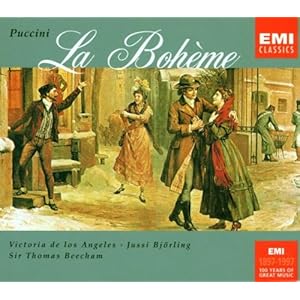
This is without a doubt my favorite recording of the opera and regarded as the greatest ever. It features Jussi Bjorling and Victoria de los Angeles. Here their voices mesh beautifully and Thomas Beecham's conducting is lush bringing out all the colors in Puccini's beloved score.


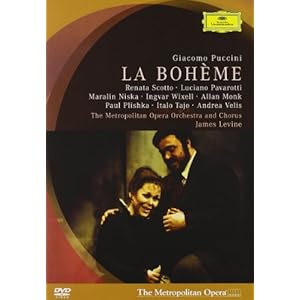
Its hard to ignore Renata  Scotto's interpretation of the role as she is by far the most dramatic Mimi I have ever heard. Her third act is tragic from beginning to end and once you get to the fourth act one is already crying. This DVD showcases her acting and vocal skills. Pavarotti while not active on stage showcases his lush voice and his beautiful high Cs.


Giacomo Puccini: La Boheme

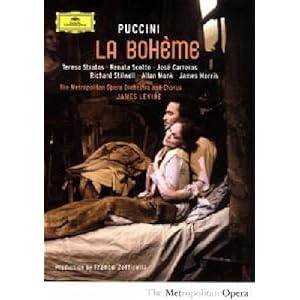
This is my favorite DVD recording. It showcases the original cast of Zeffirelli's production and Strata's versatility. Stratas in my opinion was one of the greatest actresses of that time and here she shows Mimi's frailty impeccably. Her singing while not perfect fits the role perfectly. Carreras sings ardently and Scotto while not at her vocal best shows her comic and coquettish side. (This is the Mets current production.)


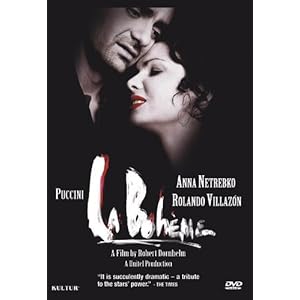
In my opinion the greatest opera movie in recent times features the glamorous opera couple Anna Netrebko and Rolando Villazon. With beautiful cinematography, gorgeous sets and colorful costumes, Robert Dornhelm's evokes the wonderful streets of Paris and Mimi's tragedy. It also features great singing from the two leads.


As for the Artists that will be performing.

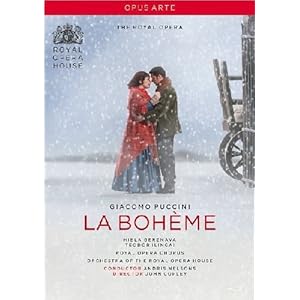
La BohemeHibla Gerzmava's acclaimed performance of Mimi is displayed in this highly acclaimed ROH production. Both these performers are compelling.


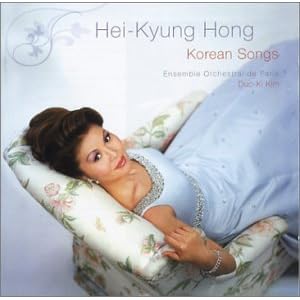
Korean Songs; Hei-Kyung HongHei-Kyung Hong's Korean album shows a new side to the diva. She traces her roots like Placido Domingo and Juan Diego Florez have done in recent albums they have recorded. The music is gorgeous and one that should not be missed.


Unfortunately Dimirti Pittas and Susanna Phillips do not have solo albums. To catch Dimitri Pittas you can see him in the Macbeth DVD the Met released. More on this for my Macbeth reccomendations.

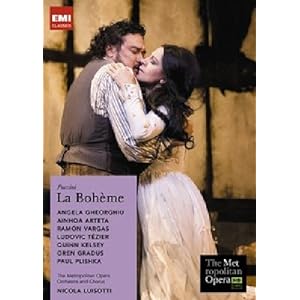
The Met also has another DVD release of La Boheme. If your curious in seeing an HD performance the Angela Gheorghiu and Ramon Vargas version is also available.
Puccini: La Boheme (Live from the Met)

Wednesday, July 6, 2011

Aida Preview 2011-12

This year Sonja Frisell's beloved production of Aida returns with a starry cast.


The Production
The current production at the Met opened back in the 80s replacing a planned production by Franco Zeffirelli because Zefirelli's was supposed to be too big and threatened to "break the bank". The sets by Gianni Quaranta evoke the splendor of Ancient Egypt: detailed, evocative and on a colossal scale. For example, the Triumphal March of Act II is brilliantly lit, with onstage trumpets, horses, near-endless formations of troops, war booty, wagon loads of corpses, prisoners and much, much more. 


The Cast
Violetta Urmana returns to the title role which was recorded live in HD and this month will be released on DVD (For more information see the DVD and CD releases of July). Two years ago she sang the role to mixed reviews. The New York Times called her performance "breathtaking" while Opera Britannica stated that Urmana's "voice rarely cuts through Verdi's heaviest orchestration."  I for one saw the opening night of this run and enjoyed her performance. While her voice can be shrill at times and her high notes unsteady, her musicality is like no other. She is probably one of the best musicians in the business today adding dramatic power and beautiful phrases to the music. Her voice is not the most beautiful but it transmits the suffering of Aida. I would not rank her amongst the greatest of all time by any means, but she is definitely one of the best Aidas at the moment.


Marcelo Alvarez returns to the Met in a new Verdi role, Radames, which he debuted in London a year ago. Reviews for this Radames were mixed. The Musical Criticism stated that he "sang beautifully throughout" while the Classical Source stated that he "sounded taxed and that he lacks the trumpet-like tonal quality one would wish for at the soldier’s more heroic and desperate passage."  After lasts seasons run of Il Trovatore I wonder if he will survive this run of Aida. Critics stated that his singing did not “sound entirely comfortable.” In last season’s Trovatore, Alvarez sounded tired and his voice lacked power, weight, and high notes. Every time he had to reach for high notes he did his best Franco Corelli impression, but the results were unpleasant to say the least. His breath control was atrocious and as result he could not phrase. He seemed to find the need to place an odd accent in his phrase as a means of support and I never did hear him shift comfortably through the passagio into his high notes.  This was best displayed in his aria “Ah si ben mio.” With Radames, Alvarez enters more dramatic territory which needs even more power and weight in the voice. Breath control is necessary and phrasing is crucial, especially in his aria “Celeste Aida” which requires him to sing at the beginning of the opera with no warmup. The addition of these Verdi roles suggests Alvarez wants to enter into heavier repertoire such as Otello, which he previewed in his last Solo recital album "Verdi Arias." The problem with this is that Alvarez is not a true spinto tenor. He is naturally a lyric tenor (his Rodolfo in "La Boheme" in Japan was much better suited to his voice).  He artificially darkens his voice to achieve the spinto color and has progressively damaged every aspect of his voice. I am rather tentative about his success with Radames at the Met. 
Stephanie Blythe returns to the Met after an exceptional Fricka. She sings her first Amneris at the Met and she may steal the show from the two principals. Her voice is huge and powerful. While she is not the greatest actor, her voice is so gripping that it is impossible to take your eyes off of her. She expresses every emotion in the music and she phrases like no other mezzo around today. My only concern is that a few years ago I heard her sing a disappointing Azucena with suspect breath control and her spotty intonation. However, the Ulrica I heard from the Chicago Opera was outstanding. In addition, a few years ago she previewed the role of Amneris at the 40th Anniversary Gala where she sang the duet between Aida and Amneris alongside Maria Guleghina. Her voice soared with intensity. Blythe has the tendency to astonish and mesmerize, so I will hold off any precautions.

Lado Ataneli sings Amonasro. While his voice is not as good as the great baritones of the 70s and 80s, he is one of the few remaining Verdi baritones. Having already seen him in the role of Amonasro in 2005, I can attest that his voice is not that big. However, it does have a good ring and good high notes. His breath control needs a little work however. Last season he sang Rigoletto and lacked the emotional power and vocal strength.  
As I stated in my Tosca preview, James Morris is no longer in the prime of his career. His voice is weaker and a little wobbly. However, he still sings with great power and still has great stage presence. Ramfis is not a huge role, but it is crucial. Morris is not known for his Verdi repertoire but when he takes one on, it turns into glorious singing. This is best displayed in the Met performance of Otello with Placido Domingo and Renee Fleming. With Morris’s presence, Ramfis will most likely be a standout role.

Conclusion:
It’s a shame that the two principals are the weakest in the cast. Still with a cast as strong as this one, this should prove to be an exciting run at the Met. 

Friday, July 1, 2011

Recording recommendations for La fille du Regiment

The following is a list of recommended recordings for the opera La fille du Regiment. This is for people who have never heard the opera or want to listen to it before going to the performance.

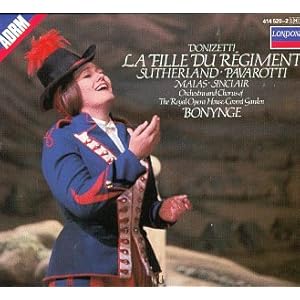
Donizetti - La Fille du Régiment / Sutherland, Pavarotti, Malas, Sinclair, ROH Covent Garden, Bonynge

Joan Sutherland and Luciano Pavaroti's legendary recording is spectacular vocally. Their voices match beautifully and their high notes are thrilling.


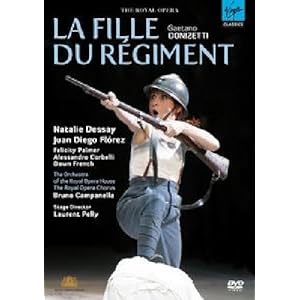
Gaetano Donizetti - La Fille du regiment / Dessay, Florez, Palmer, Corbelli, French, Campanella, Pelly (Royal Opera House 2007) Natalie Dessay and Juan Diego Florez match vocal fireworks with spectacular acting. Laurent Pelly's production is refreshing, and funny. Its a breath of fresh air. This is the current production at the Met with the original cast.


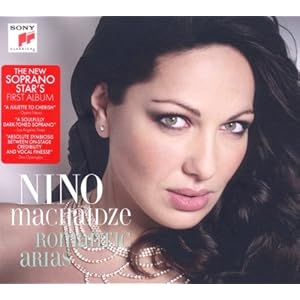
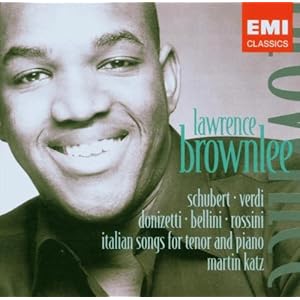
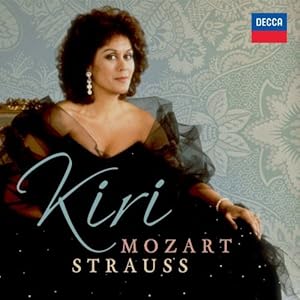
Hear are some recording of the Nino Machaidze, Lawerance Brownlee and Kiri Te Kanawa so people can listen to their voices in case they don't know them.
Romantic Arias
This is one of my highlights of July as it is Nino Machaidze's debut on Sony Classical. It displays her ability as a Bel Canto singer and it also features Marie's aria so this should be a preview of what audineces may hear when she sings the role at the Met.


Lawrence Brownlee: Songs / Lieder / MelodiesThis is Lawerance Brownlee's only recital CD so it is one to check out no matter what. You may not hear bel canto but you will hear beautiful singing.


Kiri Te Kanawa Sings Mozart & Strauss
This is Kiri Te Kanawa at her prime singing her specialty Mozart and Strauss. She won't be singing Strauss or Mozart but this is something one has to check out to see the full range of the star soprano.


For more details on La Fille Du Regiment see my preview.

Tuesday, June 28, 2011

Notable CD and DVD releases for the month of July


July Releases
Rolando Villazon crosses over to pop music in his new Deutsche Grammophon album entitled La Strada: Songs from the Movies. The album contains songs from some of Hollywood's most famous movies.


Tenor Zoran Todorovich sings Puccini, Verdi and Wagner in his new recital CD entitled Arias. The CD will be released by Oehm Classics. For those who are not familiar with Todorovich he can be seen in the Deutshce Grammphon DVD of Norma starring Edita Gruberova.


Zoran Todorovich: Arias

Nino Machaidze releases her first solo album entitled Romantic Arias. The CD released on Sony Classical features works by Massenet, Donizetti, Rossini and Bellini
Romantic Arias
Opus Arte releases a new Pique Dame from the Liceu of Barcelona. The Production by Michael Boder stars Misha Didyk, Emily Magee, Lado Ataneli, and Ludovic Tezier.


A new Falstaff is released by Art Haus starring Bernd Weikl from the PfalzTheater. The performance is conducted by Uwe Sandner.


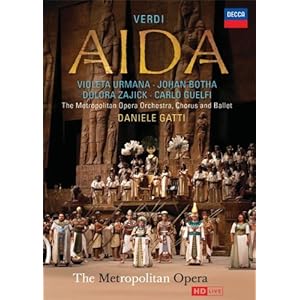
The Metropolitan Opera releases two new DVDS on Decca. The first is Aida starring Violetta Urmana who will reprise the role this upcoming season, Johan Botha, Dolora Zajick and Carlo Guelfi. Danielle Gatti conducts. The second DVD release is Turandot starring Maria Guleghina who will sing Nabucco this year at the Met, Marcello Giordani, Marina Poplavskaya and Samuel Ramey. Andris Nelsons conducts. The performances were recorded during the 2009-2010 season


Friday, June 24, 2011

Gubanova to sing all Anna Bolenas

Its official Ekaterina Gubanova will sing all the performances of Anna Bolena at the Met this season. A few months back it was announced that Elina Garanca had pulled out of the role of Jane Seymour do to pregnancy. Much was speculated about the Mezzo who would replace her but at the end of May it was announced that Ekaterina Gubanova would replace her for the initial run. The two performances in February were still not cast. However today according to the Met website, Gubanova will also sing the last two performances.

Ekaterina Gubanova made her debut at the Met in War and Peace. In 2009 she sang the new production premiere in L'Contes d'Hoffman as Giulietta. This year she replaced Olga Borodina in the role of Eboli in Don Carlo for the Met Tokyo tour. 


http://www.metoperafamily.org/metopera/season/production.aspx?id=11518

Thursday, June 23, 2011

Macbeth Preview 2011-12

Verdi's Macbeth returns to the Met in Adrian Nobles haunting production which opened in 2007.

Thomas Hampson as Macbeth and Nadja Michael as Lady Macbeth [Photo by Dan Rest courtesy of Lyric Opera of Chicago]


The Production
Adrian Noble's production of Macbeth returns to the Metropolitan Opera for the first time since its premiere run in 2007. Mr. Noble, a specialist in Shakespeare sets the opera in one of the World Wars. The set is a dark and empty circle surrounded by stylised trees. He plays with chairs, beds and the witches are dressed as grumpy old housewives. He plays with lighting using torches and lamps to create haunting imagery and great effects. The choreography in the final battle scene is some of the best the Met has to offer. While many had problems with some of Noble's choices such as Lady Macbeth rolling around the floor, I found each and everyone of his choices spectacular and captivating. The staging while minimalist is still very traditional and will most likely be at the Met for many years to come.

The Cast  
Thomas Hampson adds the role of Macbeth to his Met repertoire. For many years Mr. Hampson sang Mozart and Bel-canto roles but has slowly been changing his repertoire to pure Verdi and Puccini. In addition he has become a specialist in Mahler, a repertoire which is very focused on text. Therefore Hampson is known for approaching his roles according to the text and and emphasizing certain vowels and words in the libretto. His recent change of repertoire in my opinion this has made his voice weaker, wobbly and sound forced. His voice is that of  lyrical baritone, and therefore to small for Verdi and Puccini. However at the Met he has sang many Verdi roles including Posa in Don Carlo, Simon Boccanegra, Don Carlo in Ernani, and Germont in La Traviata. Of these roles I have had the chance to hear him do all except Posa and I can honestly say that the Don Carlo is the only one that he has excelled in. This year he faces a big challenge as Macbeth is one of the most difficult roles for baritone in the Verdi canon. He has sang the role numerous times and most recently last year at the Lyric Opera of Chicago for which he was praised for his emphasis on the text and his praising. All in all, I can't predict what Hampson will add to the role or how he will sound. As of late Hampson's voice seems more sturdy. This is can bee seen in the new Traviata release by Opus Arte and in the Tosca released by Decca. All I can hope is that he brings something new to the role.


Nadja Micheal makes her Met Debut in the role of Lady Macbeth. Hailed for her dramatic skills and her interpretation of the Salome, Michael sang Lady Macbeth alongside Hampson in the Lyric Opera of Chcago. She was hailed for her power and intensity as well as her acting skills. I have never heard Michael's voice so I am very excited to see what all the hype is about.

Macbeth Costume Sketch LMB 10110(1)

Dimitri Pittas returns to the role of Macduff, a role he triumphed in, in 2007. The New York Times hailed him for his melting sound and dramatic urgency. As I stated before in my Boheme preview, he has a beautiful voice but it is his physical that does not allow him to act or move around the stage as well. However unlike Rodolfo, Macduff is a secondary character which has important parts in the opera but is not required as much acting prowess as the two leads, Macbeth and Lady Macbeth.

.
  

Conclusion 
I expect the same chemistry Michael and Hampson had when they sang the roles in Chicago. However I can not predict how great Hampson will sound in this opera. Michael will most likely have a great debut and Pittas will probably triumph as he did last time. Finally, I suspect that audiences will love this production as much as they did when it opened regardless of what critics will say.